
Behind the Scenes of the New Aged Care Act
With the arrival of the New Aged Care Act on 1 November 2025, the work behind the scenes to have everything in place has been a major undertaking for our residential and community services teams. For residential care, the assessment and care plan process has been an important step.
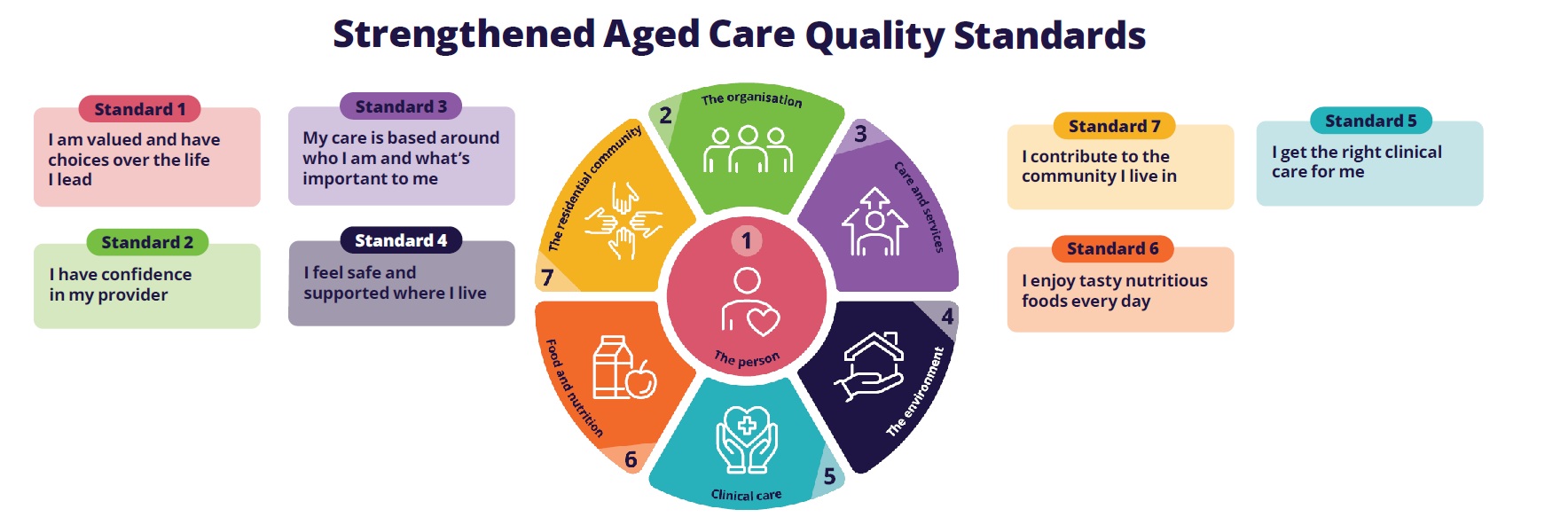
One of the many undertakings was to review the new suite of assessments and care plans in our clinical documentation system and update them to meet our clinical needs and the requirements of the Strengthened Aged Care Quality Standards.
We set up a clinical working group to undertake this work: over a period of two months, the group reviewed, reconfigured and trialled 73 assessments and 22 care plans.
When this was complete, the clinical teams met with every aged care resident to carry out a full reassessment of their care needs using the new assessments and care plans.
This process took nearly four months, during which staff met with 350 residents, 5,600 new assessments were completed, and around 3,500 care plans were developed.
The outcome is that all our residents have up-to-date rights-based care plans that reflect each person’s individual goals and preferences, presented in a new format to help make them clearer and easier to understand.
Upholding and Maintaining Standards
Vasey RSL Care is committed to upholding and maintaining the highest standards of conduct and ethical behaviour in the organisation, to promoting and supporting a culture of corporate compliance and good corporate governance, and above all, ensuring an environment that is safe for everyone.
A key part of this is making sure anyone can safely raise concerns if they notice practices or situations that may affect the safety, rights, or wellbeing of residents, staff, or the organisation.
Commonly known as ‘whistleblower legislation’, our Whistleblower Procedure ensures that a person reporting an issue (ie a whistleblower) can remain anonymous when making a disclosure about the suspected misconduct or improper circumstances in relation to dishonesty, fraud or corruption.
The procedure includes details about:
- What is an appropriate disclosure;
- How to make a disclosure;
- Options of who to make the disclosure to;
- The process of investigating a disclosure;
- How the organisation will provide support and protection to whistleblowers making a disclosure.
Community Services: Support at Home
The past few months have marked one of the most significant shifts in aged care service delivery as the new Aged Care Act and the Support at Home program came into effect on 1 November 2025. The Act is rights-based, providing clearer accountability and a more consumer-focused model.
The introduction of Support at Home marks a major shift for older Australians choosing to stay independent at home. With the many changes involved, there has been a great deal happening in the background.
Preparation
As with residential care, behind the transition we have been preparing our team, systems and processes for the new regulatory and service requirements, a major task that has kept the whole team busy for over a year.
The team was progressing well towards the Government’s original date of 1 July, so when the date was put back to 1 November to give all aged care providers and Government more time to prepare, our team was in a strong position.
Education for our Staff
Sector-wide education and training provided by the Department of Health and Aged Care and the Aged Care Quality and Safety Commission (ACQSC) has been undertaken by our Community Services team so that staff have a full understanding of both the foundations of Support at Home and strengthened Quality Standards, and the governance expectations and updated reporting obligations for providers.
Systems Preparation
We established a multidisciplinary Support at Home Working Party with six control groups to provide structured oversight across IT and systems, pricing, service updates and governance. This coordinated approach has worked well.
New Support at Home Funding Model
In order to support consistent, rights-based, person-led care, the new funding model introduces clearer service levels, increased transparency and changed participant contributions. It aims to simplify how services are understood and delivered, and how new pricing structures, service agreements and system changes are being rolled out.
The Work on the Ground
Operationally, our team has been focusing on verifying services and updating pricing, followed by the complex task of migrating Home Care Package participant data into the new Support at Home systems in readiness for new claiming and statement processes.
Maintaining continuity of care for participants is our first priority: we are committed to implementing the extensive requirements of the new Act with minimal disruption to service delivery.
Up and Running
Across our Community Services team, we believe these reforms will be beneficial to those older people who are able to remain in their own home with the care services they need.
The changes will improve our ability to communicate clearly with participants and families, increase transparency, and support informed decision-making.
Participants will notice new Support at Home statements and changes to our communication processes: these are both important steps in building confidence in the new system amid the many changes it creates for everyone.
As we move further into 2026, our focus remains on embedding these reforms while keeping participants at the centre of their care, delivering safe, reliable care services, strengthening community partnerships, and staying up to date on Support at Home.

With more than 88,000 older Australians waiting for funding approval under Support at Home and a further 120,000-plus awaiting assessment, Vasey RSL Care can provide self-funded services for those needing support in the interim. Give us a call to find out more: 03 9810 5500.